

When a parent receives a dementia diagnosis, the conversation tends to focus on the person with the diagnosis. The test results, the care plan, the medication, the prognosis.
This report is about the other person in that conversation.
The adult child who will drive to every appointment, make the calls no one else wants to make, manage the finances, cover the care gaps, and adjust their own life, career, and identity around a role that society tends to describe as ‘just what you do’.
Dementia: Who Really Cares? draws on the responses of 2,016 adults currently caring for a parent with dementia. It is part of The Hidden Toll, the largest survey Carents has ever run, covering 4,293 adults caring for ageing parents across the UK.
What the numbers say
- 96% Say they are always on alert, even when not physically present with their parent
- 89% Say support only arrives once things have broken down
- 81% Say society treats caring for a parent as "just what you do"
- 75% Receive less sympathy and recognition than new parents
2,016 Dementia carents contributed to this research
Email Your MP
Email this report to your MP
This submission came from 2,016 carents across the UK. The experiences behind it are ones Parliament needs to hear.
If any of this reflects your own situation, you can add your voice to it. MPs are more likely to act when a constituent writes to them directly. The tool below takes a few moments and sends a message to your local MP.
What we found
Four themes run consistently through the data.
1. Most dementia carents are not talking about what they are carrying
60% downplay their caring role in social situations. 56% feel ashamed admitting that caring is hard. 62% feel guilty asking for help.
This is not because they have nothing to say. Many have concluded, through experience, that being honest will cost them more than staying silent. They describe fear of being judged as weak, fear of burdening other people, and fear of responses they have already received.
One carent in the research put it directly:
"People ask how you are or how it's going but don't really want to hear how hard it ACTUALLY is or what caring for someone full time ACTUALLY entails. So it's just easier to say I'm fine."
That is not an unusual response. It is the pattern.
2. Dementia carents are always on
96% say they are always on alert, even when they are not physically present. For dementia carents, that alertness can take on a particular quality. It is not only waiting for the phone to ring. It is holding the awareness of a person who may not know where they are, who may not remember you will be back, as you sit at your desk or try to sleep or speak to someone else.
"Never off my mind. Always waiting for a response from the alarm system. I can never really relax."
3. The system waits for crisis
89% say support only arrives when things have broken down. This is not only a resource problem. It is a design problem. Assessments tend to be triggered by crisis, not by need. By the time someone crosses the threshold, many carents have been managing without any support for months or years.
For dementia carents this matters particularly. The condition does not arrive with a single acute event. It is gradual and cumulative. Carents can find themselves far into a situation before anyone in the system has noticed they are there.
"Finding support and getting it via adult services was the most stressful thing I have ever had to do. I was passed from pillar to post with no one taking responsibility. It took 15 months."
4. Dementia carents are losing themselves
Carents were asked how caring had changed how they see themselves and what they described, consistently, was a form of identity loss: careers stalled or ended, friendships thinned, a sense of self gradually displaced.
"I look back at my pre-caring self and barely remember that person."
"I don't exist anymore. I just do. I look and feel older than my parent."
"It's dimmed my light. I'm a butterfly trapped in a jar, no way out."
What needs to change
Carents is calling on the Government to take three specific steps.
Appoint a National Dementia Lead.
There is currently no single point of accountability within Government for dementia. A named lead, responsible for coordinating policy across health, social care, and employment, would ensure that both the person with the diagnosis and those caring for them are visible to the system.
Fund dementia in line with its true cost and impact.
Dementia is the leading cause of death in England and Wales. Its costs fall disproportionately on families. The unpaid contribution of carents to the UK economy is valued at more than £100 billion a year. With the number of people living with dementia in the UK projected to double by 2040, public investment must reflect that reality.
Guarantee proactive support for carents from diagnosis onwards.
89% of dementia carents say support only arrives when things have broken down. A dementia diagnosis does not affect one person. It affects two. Carents should be identified at the point of diagnosis and offered consistent, proactive support from that moment forward.
Download Dementia: Who Really Cares
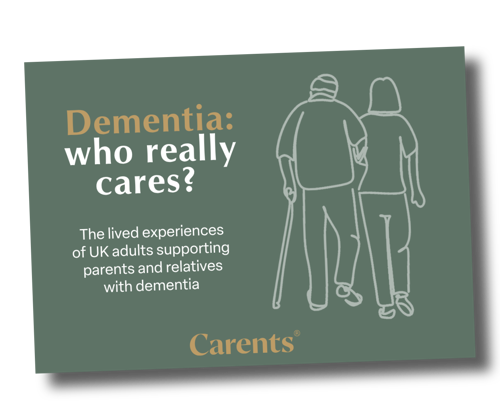
For the full picture of what 2,016 dementia carents told us, download the full report of Dementia: Who Really Cares.
Simply fill in your details and the report will be sent to you.
About this research
Dementia: Who Really Cares? draws on the dementia cohort of The Hidden Toll, Carents' flagship research programme. The survey covered 4,293 adults caring for ageing parents across the UK, conducted between January and March 2026. The dementia cohort comprises 2,016 respondents currently caring for a parent with dementia. The Hidden Toll is the largest survey of its kind into the lived experience of adult children of ageing parents in the UK.
Full methodology is available on request. Contact hello@carents.co.uk
Did you find this information helpful? Let us know what you think or pass on some advice to other carents by emailing us at hello@thecarentsroom.com
Last updated: 29/07/2026