

The Casey Commission on Adult Social Care is the most significant review of social care in a generation. When it was announced, we opened a survey to our community and asked one question: what do you want them to know?
414 people responded. They gave their consent for every word to be passed on. This is what they said.
This submission does not represent Carents' policy positions. It represents what 414 people caring for ageing parents and relatives told us, in their own words, about a system they are navigating every day. We sent the Commission every response. This page is the summary.
Who responded?
414 carents responded with full consent from 439 total survey completions. Many are caring for people at the very end of a long life: loved ones in their 80s and 90s, most with several long-term conditions at once. Most respondents described relatives who were, in their own words, in their final months or final year.
-
91% (377 people) are caring for an ageing parent or parent-in-law
-
8% (35 people) are caring for an ageing partner or spouse
-
Responses came from every English region, plus Scotland, Wales, and Northern Ireland
This submission is genuinely national. The problems it describes are not local.
What they told us
Seven themes emerged consistently across all 414 responses. They are presented here in order of how commonly they were raised.
- 77% raised delays and assessments that arrived too late
- 70% raised concerns about care workforce pay, staffing, or dignity
- 69% raised financial concerns about care costs or means-testing
- 68% described problems with communication between services and agencies
- 61% described the emotional and mental health toll on themselves as carents
- 54% described coordination failures and excessive administrative burden
Runs throughout: the need for a single point of access
Download our Casey Commission Submission
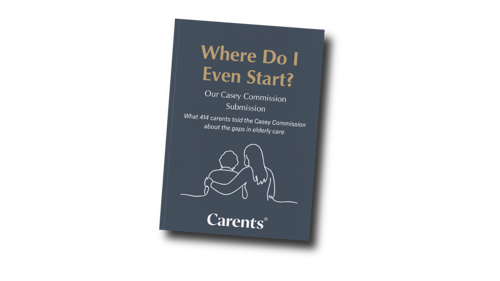
For the full picture of what 414 carents told us to submit to the Casey Commission, simply fill in your email address and we'll send it to your inbox.
Waiting while things get worse
77% of responses raised delays, waiting times, or assessments that arrived too late to be useful.
For families caring for people at the very end of a long life, delay is not an inconvenience. It can mean the person being cared for deteriorates past the point where the support would have helped, or does not live to receive it at all.
"Mum doesn't have a dementia diagnosis. She is 94 and has waited over a year for the memory clinic. She may not be here by the time she would be seen. But without a diagnosis it appears that a person needs that label to open doors."
CC-002, East Midlands
A workforce in crisis
70% of responses raised concerns about care workforce pay, staffing levels, continuity of care, or dignity standards.
The picture that emerges is not primarily one of individual failure. Respondents describe dedicated workers doing their best within an under-resourced system. The problem is structural: low pay produces high turnover, high turnover produces unfamiliar faces, and unfamiliar faces produce care that cannot be responsive to the person receiving it.
"The care agency had several really good carers but were always short-staffed. This meant they would sometimes not come in to do the lunch visit. I had to drive over to cover and was often not told until after the time they were supposed to arrive."
CC-149, West Midlands
The cost of caring
69% of responses raised financial concerns about adult social care costs or the means-testing system.
The £23,250 threshold is named repeatedly. For families whose parent has just received a diagnosis of dementia or a deteriorating long-term condition, the realisation that their entire financial future may be consumed by care costs is frequently described as the first major shock of navigating the system.
"Mum has worked her whole life to scrimp and save what little she has and now with a diagnosis of dementia this will not get her very far. Feel utterly hopeless about the state of elderly care in this country"
CC-001, North East
Lost in the system
68% of responses described problems with communication between services, agencies, or care providers.
The single practical change that respondents ask for most consistently is a named contact: one person who knows their family's situation and can be reached when something goes wrong.
"Having to repeat myself, tell my story over and over again, as information is not shared. Having to go through the motions of exploring care options that I know are not suitable or safe, so they cannot accuse me of being obstructive."
CC-002, East Midlands
The unseen cost
61% of responses described the emotional and mental health impact of caring on the carent themselves.
What makes these accounts particularly striking is how rarely respondents ask for anything for themselves. They ask for better systems, for fair pay for care workers, for their parents to be treated with dignity. Their own wellbeing appears almost incidentally.
"Please can you realise that unpaid carers do not apply for the job that nobody really wants: a job with no salary, no perks, no holiday, no promotion prospects, and where the only outcome is generally the death of the person you are caring for, or indeed your own."
CC-013, East Midlands
Nobody talks to anyone
54% described coordination failures between agencies, departments, or services. 31% described excessive paperwork, repeated form-filling, or box-ticking.
Families describe being responsible for communicating between a GP, a social worker, a district nurse, a care agency, and a hospital discharge team, none of whom use the same systems and none of whom holds the full picture.
"I believe there is insufficient dialogue between agencies when looking at the overall care of an individual. Things seem too compartmentalised. There are too many people with partial pictures and no one person responsible for the whole."
CC-005, South East
Where do I even start?
Running beneath every other theme is a more fundamental problem: there is no front door.
The entry points to the system are multiple, inconsistent, and often invisible until you already know what you are looking for.
By the time most carents find Carents.co.uk, they have already spent weeks or months trying to navigate alone.
"Need for a 'one stop' helpline. And more advice. Like 'before you start primary school', a 'before you get old' type campaign."
The hidden carent problem
182 people (44% of consenting respondents) are not registered as carers. Most did not know they could be.
This is one of the most significant findings in the submission. The reasons cluster into three groups:
They did not know they could register. The most common reason by a substantial margin. They did not know carer registration was possible, that it might entitle them to support, or that it was something anyone expected them to do.
"Nobody asked me if I was one. I did not even know this was something else I had to do."
CC-009, Greater London
They do not identify as a "carer". These respondents reject the identity label, not the support. They are daughters, sons, partners. The word "carer" belongs to someone else.
"I do not think anything would be gained by it in my situation. I do like the term 'Carent'."
CC-032
They are still working. A third group are not registered because they remain in paid employment, not realising that work does not preclude registration.
If nearly half the people actively caring for an ageing relative are not registered, every figure relating to carents being supported, every dataset on carer needs assessments, and every service designed to support unpaid carents is built on a significant undercount.
What carents asked for: ten asks
These asks are drawn directly from the responses. They are not Carents' policy positions. They are what 414 carents told us they need. We asked the Commission to consider each one.
-
Fix the wait. Introduce statutory maximum timescales for needs assessments, with fast-track pathways for families supporting someone in the final stages of a life-limiting condition.
-
Fix the workforce. Establish a sector-wide minimum pay floor for care workers. Publish a long-term workforce strategy. Enforce dignity standards.
-
Fix the funding. Reform the means-testing threshold and introduce a lifetime cap on care costs that genuinely protects family assets.
-
One person who knows us. Guarantee a named contact for every family navigating adult social care: one person who knows their situation, can be reached, and is accountable for coordinating across agencies.
-
See the carent, not just the cared-for. Guarantee regular, independent carer wellbeing assessments, offered proactively and followed by meaningful support, including funded respite.
-
Join up the records. Invest in shared digital infrastructure so that health, social care, and housing services can access a single, up-to-date record. Families should not be the only part of the system that holds all the information.
-
Tell us once. Eliminate duplicate assessments. No family should complete separate assessments for different arms of the same care system.
-
Find us before we find you. Move from opt-in to proactive carer identification. GPs, hospitals, and social workers should identify unpaid carents automatically.
-
Design for how families actually live. Acknowledge and design for long-distance and cross-border caring. A significant and growing proportion of the people organising adult social care in England do not live near the person they care for.
-
Give us a front door. Commission a single point of access for families supporting an ageing relative, with a proactive national information campaign targeted at people approaching the caring years.
About this submission
Where Do I Even Start? was submitted to the Casey Commission on Adult Social Care in April 2026. It draws on 414 responses from the Carents community, each given with full consent for inclusion. Responses came from 439 total survey completions. The submission is national in character, with representation from all English regions and from Scotland, Wales, and Northern Ireland.
Carents.co.uk is the UK's support hub for adults managing the care of an ageing parent: over 75,000 people who are daughters, sons, and partners before they are carers, managing the final years of a parent's life, often from a distance, often while working, often while ageing themselves.
Did you find this information helpful? Let us know what you think or pass on some advice to other carents by emailing us at hello@thecarentsroom.com
Last updated: 18/05/2026